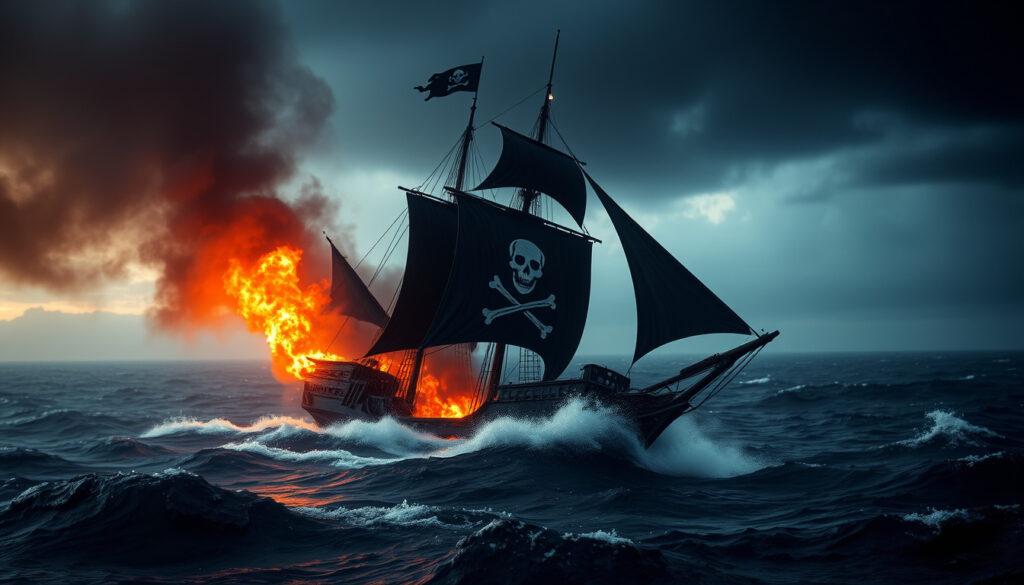
Edward Teach – The Real Blackbeard Biography, Ship and Death
Edward Teach, better known as Blackbeard, was an English pirate who terrorised the Caribbean and the eastern coast of Britain’s North American colonies during the early 18th century. His career as a pirate captain lasted only about two years, yet his theatrical appearance, calculated brutality, and violent death turned him into the most enduring icon of piracy in popular culture.
Born around 1680, likely in or near Bristol, England, Teach probably began his maritime career as a privateer during Queen Anne’s War. When the war ended in 1713, he turned to piracy, eventually commanding a fearsome ship called the Queen Anne’s Revenge. His reputation was built on more than just success at sea – he used psychological terror, such as weaving smoldering fuses into his long black beard, to intimidate his victims.
His life ended on November 22, 1718, when Lieutenant Robert Maynard of the Royal Navy cornered him at Ocracoke Island, North Carolina. After a bloody hand-to-hand fight, Teach was killed and his head brought back to claim a £100 reward. Today, the name Blackbeard remains synonymous with the Golden Age of Piracy, but separating fact from fiction requires a careful look at the historical record.
Who Was Edward Teach? The Real Blackbeard
Edward Teach (Blackbeard) at a Glance
- Full Name: Edward Teach (also spelled Thatch)
- Known As: Blackbeard
- Born: c. 1680 (likely Bristol, England)
- Died: November 22, 1718 (Ocracoke Island, North Carolina)
- Primary Ship: Queen Anne’s Revenge
- Active Period: c. 1716–1718
Key Insights from the Historical Record
- Blackbeard’s piracy career lasted only about two years, yet he became the most iconic pirate in history.
- Historical records show he was a calculated leader who used psychological terror (lit fuses in his beard) to avoid bloodshed.
- The wreck of Queen Anne’s Revenge was discovered in 1996 off the coast of North Carolina, confirming many details of his career.
- There is no credible evidence that Blackbeard ever buried treasure anywhere.
- Edward Teach is confirmed to have married Mary Ormond (or Ormand) in Bath, North Carolina, in 1718.
Key Facts: Edward Teach
| Fact | Source |
|---|---|
| Real name Edward Teach, also recorded as Thatch | NPS |
| Born c.1680, likely in Bristol, England | Britannica |
| Served as a privateer during Queen Anne’s War before turning pirate | QAR Online |
| Commanded a fleet of four ships at his peak, with Queen Anne’s Revenge as flagship | Royal Museums Greenwich |
| His flag showed a skeleton holding an hourglass and a spear stabbing a heart | NPS |
| Famous for lighting fuses in his beard to frighten enemies | Smithsonian |
| Killed by Lieutenant Robert Maynard at Ocracoke Island on November 22, 1718 | Wikipedia |
| Reported to have taken 14 wives (legend), but only one historical wife: Mary Ormond | Historical records |
Was Edward Teach Married? Personal Life of the Pirate
The historical record on Blackbeard’s personal life is thin. The South Carolina Encyclopedia notes that while he was reputed to have had numerous wives, documentary evidence identifies only two unnamed women – one in London and one in Bath, North Carolina. Royal Museums Greenwich states that Charles Johnson’s 1724 biography of pirates claimed he had fourteen wives, but documentation supports only one legal marriage.
The story of Blackbeard having 14 wives appears in Captain Charles Johnson’s A General History of the Pyrates, but historians agree it is likely exaggerated. Only one marriage – to Mary Ormond in Bath, North Carolina – is supported by verifiable records. The rest belongs to pirate lore rather than established fact.
The marriage to Mary Ormond took place in 1718, shortly before Blackbeard’s death. There are no confirmed records of children from this union. The lack of reliable documentation about his personal life has allowed legends to flourish, but the evidence points to a far less colourful private life than the stories suggest.
What Was the Name of Blackbeard’s Ship? Queen Anne’s Revenge
Edward Teach is most closely associated with the ship Queen Anne’s Revenge. The vessel was originally a French slaver named La Concorde that Teach captured in November 1717. He renamed it, heavily armed it, and used it as his flagship for about seven months.
From Slave Ship to Pirate Flagship
After capturing La Concorde, Teach kept a French crew member to work the ship and turned it into a formidable pirate vessel. At its peak, he commanded a small fleet of four ships, with Queen Anne’s Revenge leading the group. Its size and firepower made it one of the most famous pirate ships of the era.
The Wreck and Discovery
In June 1718, Teach deliberately ran the ship aground near Beaufort Inlet, North Carolina. Many historians believe he did so to reduce costs and keep a larger share of the plunder for himself and a smaller crew. The wreck was rediscovered in 1996 by the Queen Anne’s Revenge Project, a North Carolina government initiative that has since recovered thousands of artifacts.
Excavations of the shipwreck have confirmed its origin and size. Artifacts include cannons, anchor parts, medical equipment, and navigational tools. The project has provided concrete evidence for many details of Blackbeard’s career that were previously uncertain.
What Does the Blackbeard Flag Look Like?
Blackbeard’s pirate flag was designed to instill fear rather than serve as a simple identifier. The National Park Service describes the flag flying over Queen Anne’s Revenge as showing a heart dripping blood, a skeleton holding an hourglass and a spear. Royal Museums Greenwich gives a similar description, noting a horned skeleton stabbing a heart with its spear while holding an hourglass – a symbol of mortality.
The exact artistic details vary by historical account, but the meaning is consistent: intimidation. The hourglass represented the time running out for the victims, while the heart and spear signified violence and death. The flag remains one of the most recognizable symbols of piracy, even though its design is not fixed in the historical record.
How Did Blackbeard Die? The Battle of Ocracoke
Blackbeard was killed on November 22, 1718, in a bloody fight with Lieutenant Robert Maynard and a force sent by Virginia Governor Alexander Spotswood. The confrontation took place near Ocracoke Island, North Carolina, where Teach was cornered after months of raiding.
Accounts describe a fierce hand-to-hand battle. Despite being outnumbered, Blackbeard fought until he sustained multiple wounds. Maynard and his men eventually killed him, and the lieutenant reportedly brought Teach’s severed head back to shore to claim the £100 reward offered by the governor.
Blackbeard’s death was not a dramatic execution but a violent skirmish at sea. The popular image of a pirate being killed in a sword fight is true in this case, but the details are often romanticised. Maynard’s ambush was a carefully planned operation, not an accidental encounter.
Did Blackbeard Have Treasure?
The idea of Blackbeard burying a vast treasure on a deserted island is one of the most persistent pirate legends, but the historical evidence does not support it. Sources from the Smithsonian, North Carolina History Project, and History.com all emphasise that Blackbeard captured ships, took cargo, and demanded ransom rather than amassing a hidden hoard.
North Carolina sources note that authorities pursued him in part because of the value of his captured goods, but they do not confirm any famous buried treasure. The legend likely grew from fictional accounts such as Robert Louis Stevenson’s Treasure Island and later popular culture. In reality, any wealth Blackbeard accumulated was quickly spent or divided among his crew.
A Timeline of Edward Teach’s Life and Career
- c. 1680 – Born, possibly in Bristol, England.
- 1701–1714 – Serves as a privateer during Queen Anne’s War.
- c. 1716 – Begins piracy under Captain Benjamin Hornigold.
- 1717 – Captures French slave ship La Concorde; renames it Queen Anne’s Revenge.
- May 1718 – Blocks Charleston, South Carolina, harbour.
- June 1718 – Queen Anne’s Revenge runs aground near Beaufort, North Carolina.
- November 22, 1718 – Killed in battle with Lieutenant Robert Maynard at Ocracoke Island.
- 1996 – Wreck of Queen Anne’s Revenge discovered.
What We Know vs. What Is Legend
| Established Information | Information That Remains Unclear |
|---|---|
| Edward Teach existed and was a pirate under the name Blackbeard. | The exact location of his birth is unconfirmed (likely Bristol). |
| He died in battle with Royal Navy forces in 1718. | Stories of buried treasure are legendary with no historical evidence. |
| He commanded a ship called Queen Anne’s Revenge. | Claims of 14 wives are almost certainly exaggerated. |
| He married Mary Ormond in Bath, North Carolina. | The exact design of his flag is debated by historians. |
Historical Context: The Golden Age of Piracy
Edward Teach operated during the peak of the Golden Age of Piracy (c. 1650s–1730s), a period driven by post-war economic instability, weak colonial governance, and the availability of unemployed privateers. After the end of Queen Anne’s War in 1713, many experienced sailors turned to piracy, including Teach.
His short but dramatic career, combined with his theatrical appearance and violent death, made him the archetypal pirate in literature and film. Modern archaeology, particularly the discovery of the Queen Anne’s Revenge shipwreck, has provided unprecedented data that confirms many details of his career. The wreck’s artifacts are now on display at the North Carolina Maritime Museum.
Primary Sources and Expert Quotations
“This book, attributed to Captain Charles Johnson, is the primary historical source for Blackbeard’s biography.”
— A General History of the Pyrates (1724)
“Blackbeard was a master of psychological warfare, using his fearsome appearance to intimidate victims.”
— Royal Museums Greenwich
Archaeological evidence from the Queen Anne’s Revenge confirms the ship’s origin and size.
— NC Department of Natural and Cultural Resources
Where to Learn More or Visit
If you wish to delve deeper into the real story of Edward Teach, several resources and locations offer authoritative information. The North Carolina Maritime Museum displays artifacts from the Queen Anne’s Revenge wreck. Ocracoke Island features historical markers at the site of his death. For a scholarly account, read Angus Konstam’s book Blackbeard: America’s Most Notorious Pirate. You can also explore the National Park Service profile and the Wikipedia article. For a museum perspective, see the Royal Museums Greenwich page. The Britannica entry also offers a concise overview. Another early colonial figure connected to the same era is John Smith, while the region of Sierra Leone played a role in the maritime trade routes frequented by pirates.
Frequently Asked Questions About Edward Teach
Who is Blackbeard in One Piece?
In the anime and manga One Piece, “Blackbeard” is the alias of Marshall D. Teach, a major antagonist loosely inspired by Edward Teach.
Where was Edward Teach born?
Most historical accounts place his birth in Bristol, England, around 1680, though some sources suggest other locations. It is not definitively confirmed.
How long did Blackbeard’s piracy last?
Blackbeard’s career as a pirate captain spanned roughly two years, from 1716 to his death in November 1718.
Did Blackbeard have children?
There are no confirmed historical records of Edward Teach having children with his wife Mary Ormond.
What was Blackbeard’s real name?
His real name was Edward Teach, also recorded as Thatch in some contemporary documents.
Was Blackbeard a privateer before becoming a pirate?
He likely served as a privateer during Queen Anne’s War before turning to piracy after the war ended in 1713.
How many ships did Blackbeard command?
At his peak, he commanded a fleet of four ships, with Queen Anne’s Revenge as his flagship.
Where can I see Blackbeard artifacts today?
The North Carolina Maritime Museum displays many artifacts recovered from the Queen Anne’s Revenge shipwreck.
More related posts
 Bideford Bay Holiday Park – Facilities Reviews Prices 2025 Guide
 Black Mirror Loch Henry – Plot Cast Ending Explained
 Jane Seymour – Tudor Queen vs Hollywood Actress Explained
 Bianca Belair – Husband, Pregnancy, EST Meaning & Full Bio 2025
 Tesco Share Price Uk – Live Price, Forecast & How to Buy
 Morena Baccarin – Biography, Net Worth, Movies and TV Shows
 Marks and Spencer Dundee – Store Guide, Hours, Jobs and Updates
 Scott Eastwood – Biography, Movies, Family and Net Worth