How Much Vitamin D3 Should I Take Daily – RDA Chart and Safe Limits
Vitamin D3 supplementation has become a cornerstone of preventive health, yet confusion persists about optimal daily intake. Unlike water-soluble vitamins, this fat-soluble nutrient accumulates in body tissue, making precise dosing essential for safety and efficacy.
Determining your ideal daily amount depends on age, body weight, sun exposure habits, and existing blood levels. While general recommendations provide a baseline, individual needs vary significantly based on physiological factors and geographic location.
Health authorities including the NIH and Mayo Clinic have established specific thresholds to guide supplementation, balancing deficiency prevention against toxicity risks.
What Is the Recommended Daily Dosage of Vitamin D3?
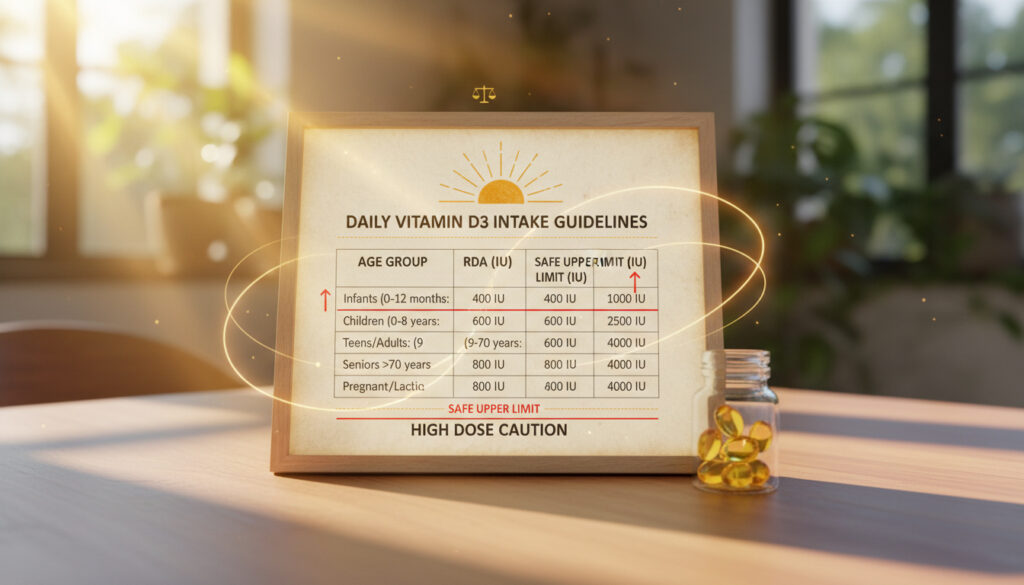
| Age Group | RDA (IU) | Upper Limit (IU) | Notes |
|---|---|---|---|
| Adults 19-70 | 600 | 4,000 | IOM/NIH standard |
| Adults >70 | 800 | 4,000 | Increased for bone health |
| Deficient adults | 1,000-5,000* | Consult doctor | Short-term only |
*Physician-supervised therapy
- Adults under 70 require 600 IU (15 mcg) daily to maintain bone health
- Seniors over 70 need 800 IU (20 mcg) due to reduced skin synthesis
- The tolerable upper intake level (UL) is 4,000 IU for all adults
- Vitamin D3 raises blood levels more effectively than D2
- Sun exposure cannot cause toxicity due to skin self-regulation
- Higher body weight may necessitate increased dosages
- Endocrine Society suggests higher targets (1,500-2,000 IU) for some individuals
| Fact | Source |
|---|---|
| RDA for adults 19-70 is 600 IU | NIH Office of Dietary Supplements |
| RDA for adults >70 is 800 IU | Mayo Clinic |
| Upper limit is 4,000 IU daily | Cleveland Clinic |
| D3 is more effective than D2 | Healthline |
| Toxicity occurs at >150 ng/mL blood levels | NIH |
| Sun exposure cannot cause overdose | NIH |
| Deficiency symptoms include fatigue and bone pain | WebMD |
| Higher BMI requires adjusted dosing | Healthline |
What Are the Safe Upper Limits for Vitamin D3?
Chronic intake exceeding 4,000 IU daily risks hypervitaminosis D, a condition causing dangerous calcium buildup in blood and tissues. While this threshold represents the official tolerable upper intake level, individual tolerance varies based on body mass and baseline status.
Blood concentrations exceeding 150 ng/mL (375 nmol/L) indicate vitamin D toxicity, according to NIH guidelines. Symptoms typically emerge when levels surpass 50-60 ng/mL.
Recognizing Overdose Symptoms
Hypercalcemia from vitamin D toxicity manifests through nausea, vomiting, and weakness. Patients may experience dehydration, confusion, and irregular heart rhythms. Kidney stones and acute kidney damage represent serious complications requiring immediate medical intervention.
Long-Term Risks
Mayo Clinic specialists emphasize that sustained intake above 4,000 IU daily without medical supervision may lead to vascular calcification. Prescription-level doses require regular monitoring of serum calcium and 25-hydroxyvitamin D concentrations.
Vitamin D3 vs. Vitamin D2: Which Is Best and Why?
Cholecalciferol (D3) and ergocalciferol (D2) differ fundamentally in molecular structure and biological activity. D3, synthesized in human skin, demonstrates superior bioavailability and longer half-life in circulation.
Efficacy Comparisons
Research consistently shows D3 raises and maintains serum 25-hydroxyvitamin D concentrations more effectively than D2. This superiority becomes particularly significant for long-term supplementation strategies aimed at correcting deficiency states.
Source and Stability
D3 typically derives from animal sources like lanolin or fish oil, while D2 comes from plant sources and fungi. D3’s enhanced stability and potency have made it the standard in pharmaceutical and over-the-counter supplements.
Best Practices for Taking Vitamin D3 Daily
Absorption of this fat-soluble vitamin depends critically on dietary context. Taking supplements alongside meals containing healthy fats maximizes intestinal uptake compared to ingestion on an empty stomach.
Consume vitamin D3 supplements with avocado, nuts, olive oil, or fatty fish to improve bioavailability significantly compared to fasting states.
Timing Considerations
While no specific hour proves superior, consistency matters more than clock time. Daily dosing maintains steadier blood concentrations than weekly bolus dosing, though both approaches can achieve sufficiency when properly managed.
For readers seeking structured daily routines, exploring American State Crossword Clue – Common 4-5 Letter Answers can provide the same methodical approach to supplementation scheduling that puzzle enthusiasts apply to their daily cognitive exercises.
How Much Vitamin D3 Do You Need If Deficient?
Deficiency correction requires pharmaceutical-grade dosing typically ranging from 1,000 to 5,000 IU daily, administered under physician supervision. These therapeutic doses exceed maintenance recommendations and necessitate quarterly blood monitoring.
High-dose vitamin D3 therapy for deficiency requires baseline and follow-up 25-hydroxyvitamin D testing to prevent inadvertent toxicity.
Prescription Protocols
Healthcare providers may prescribe 50,000 IU weekly for severe deficiency, converting to maintenance doses once serum levels reach 30-50 ng/mL. Such aggressive treatment demands concurrent calcium monitoring.
Monitoring Response
Patients should expect 8-12 weeks to reach optimal blood concentrations. Symptoms like fatigue and muscle weakness typically resolve within this timeframe, though bone density improvements require months of sustained sufficiency.
How Have Vitamin D Guidelines Evolved?
- 2010: Institute of Medicine (IOM) establishes current RDAs (600-800 IU) and 4,000 IU upper limits based on skeletal health outcomes.
- 2011: Endocrine Society publishes higher target ranges (40-60 ng/mL), suggesting many adults need 1,500-2,000 IU daily.
- 2015: NIH confirms sun exposure cannot produce toxicity due to epidermal regulation mechanisms.
- Current: No major 2024 guideline revisions; consensus maintains 2010 IOM recommendations as the safety baseline for seniors and adults.
What Is Established vs. Still Unclear About D3 Dosage?
| Established Facts | Areas of Uncertainty |
|---|---|
| 600-800 IU meets basic needs for most adults | Optimal levels for immune function beyond bone health |
| 4,000 IU is the safe upper limit | Genetic variations in vitamin D binding protein affecting dosing |
| D3 outperforms D2 in raising blood levels | Long-term effects of maintaining 40-60 ng/mL vs. 20-50 ng/mL |
| Deficiency causes bone disease and fractures | Precision dosing for obesity (BMI >30) |
| Sun cannot cause overdose | Interaction effects with common medications |
NIH health professional guidelines confirm these established thresholds while noting ongoing research into individualized medicine approaches.
Factors Influencing Your Vitamin D3 Requirements
Several physiological and environmental variables alter individual vitamin D needs beyond standard recommendations. Body composition plays a significant role; adipose tissue sequesters vitamin D, meaning individuals with obesity often require two to three times higher doses to achieve equivalent serum concentrations.
Skin pigmentation affects synthesis efficiency. Higher melanin levels act as natural sunscreen, requiring darker-skinned individuals to spend significantly more time in sunlight or rely more heavily on supplementation. Geographic latitude and seasonal variations further complicate baseline calculations, with winter months in northern climates eliminating sufficient UVB radiation for dermal production.
Age remains the most consistent factor. After age 70, skin thickness decreases by 20-30%, dramatically reducing vitamin D synthesis capacity. This physiological decline explains the increased RDA for seniors and the prevalence of deficiency in institutionalized elderly populations. Those managing complex schedules for elderly care might find resources like O2 Customer Service Opening Times – 24/7 Phone and Contact Details helpful when coordinating medical appointments and prescription deliveries.
What Do Leading Health Authorities Recommend?
Medical institutions emphasize testing before supplementing. The NIH Office of Dietary Supplements maintains that 600 IU suffices for 97% of healthy adults under 70, while the Endocrine Society argues for higher targets in at-risk populations.
“The recommended dietary allowance for adults is 600 IU daily, increasing to 800 IU after age 70.”
— NIH Office of Dietary Supplements
“Health care providers may prescribe higher doses to treat vitamin D deficiency, but these should only be taken under medical supervision with regular blood monitoring.”
— Mayo Clinic
What Is the Bottom Line for Daily Vitamin D3?
Daily vitamin D3 requirements range from 600 IU for most adults to 800 IU for seniors, with 4,000 IU representing the absolute safe ceiling without medical supervision. Individual factors including weight, skin tone, and existing deficiency status necessitate personalized protocols verified through 25-hydroxyvitamin D blood testing. For those considering supplementation beyond standard recommendations, consultation with healthcare providers ensures safe optimization of this essential nutrient.
Frequently Asked Questions
Is 2,000 IU of vitamin D3 too much to take daily?
No, 2,000 IU remains below the 4,000 IU upper limit for adults. However, long-term intake above 1,500 IU should ideally follow blood testing to verify necessity and monitor levels.
What is the best vitamin D3 dosage specifically for women?
Women follow the same RDA as men: 600 IU daily for ages 19-70, 800 IU for those over 70. Pregnant or breastfeeding women should consult doctors as needs may vary.
Can vitamin D3 supplements help with weight loss?
While obesity correlates with deficiency due to fat sequestration, vitamin D3 is not a weight loss agent. Supplementation corrects deficiency but does not directly induce fat loss.
How does vitamin D3 specifically support bone health?
It enhances calcium and phosphorus absorption in the intestines, maintains serum calcium balance, and prevents rickets and osteomalacia by enabling bone mineralization.
How long does it take to correct a vitamin D deficiency?
With standard supplementation, blood levels typically normalize within 8-12 weeks. Severe deficiency may require 3-6 months of high-dose therapy under medical supervision.
Can you get enough vitamin D3 from sunlight alone?
Possibly, if you live near the equator and get 10-30 minutes of midday sun exposure several times weekly. However, skin cancer risk, season, latitude, and age often make this impractical.
Should vitamin D3 be taken every day or weekly?
Daily dosing maintains more stable blood levels, though weekly high doses can work for deficiency correction. Consistency matters more than specific scheduling.
More related posts
 Nathan Evans – Bio, Music, Net Worth, and Tour Updates
 David Baddiel – Comedian, Author, and Parkinson’s Diagnosis
 Boys Haircuts Long on Top – Teen Trends 2025
 Reading and Leeds 2026 – Lineup Dates and Tickets Guide
 Kiernan Shipka – Biography, Age, Height, and Most Famous Roles
 Leeds United vs Stoke City Standings – 2024-25 Championship Comparison
 Aidan Gillen Movies and TV Shows – Complete Filmography and Best Roles
 Mick Foley – Net Worth, AEW Status and Personas 2025