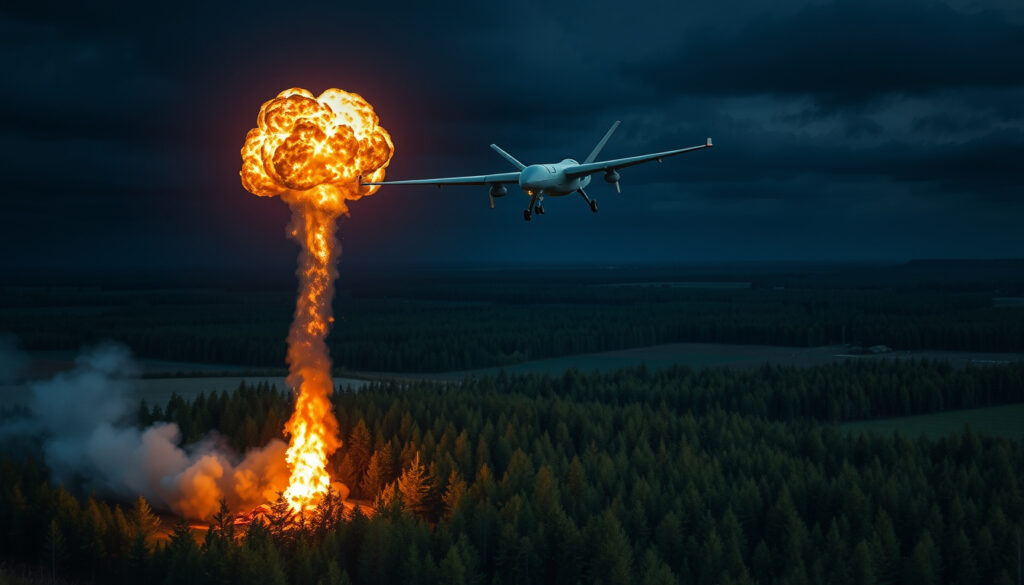
On the night of September 9-10, 2025, a significant escalation in cross-border tensions unfolded as Russian military drones penetrated Polish airspace for approximately seven hours. The incursion, involving 19 to 24 unmanned aerial vehicles, marked the largest such violation since Russia’s full-scale invasion of Ukraine in 2022.
Polish defence forces, supported by NATO allies, responded decisively, shooting down at least three and possibly four of the incoming drones. The incident prompted immediate consultations under NATO’s Article 4 and triggered a diplomatic response that reached the United Nations Security Council.
Despite the scale of the operation and its unprecedented duration, no casualties were reported, though minor damage to residential areas occurred in several villages. The event has since been characterised by Polish authorities as a deliberate test of NATO’s eastern flank capabilities.
Russian Drones in Poland
Poland invoked NATO Article 4 for consultations on the security threat, marking the first time the alliance convened such talks specifically over a drone incursion.
What happened during the incursion?
The incursion began at approximately 23:30 on September 9, 2025, as Russian drones entered Polish airspace from Belarusian territory. The timing coincided with a massive Russian drone and missile barrage against Ukraine, involving approximately 415 unmanned systems. Most of the drones approaching Poland transited through Belarus airspace before crossing into Polish territory.
The operation lasted about seven hours, ending around 06:30 on September 10. During this window, multiple waves of drones traversed eastern, central, and northern Poland, with debris subsequently discovered as far as 250 kilometres inland.
Who was involved in the response?
Polish military assets were deployed immediately upon detection. Polish F-16 fighter aircraft intercepted several drones, while Dutch F-35 jets and Italian AWACS surveillance aircraft supported the operation. German Patriot air defence systems were activated and engaged incoming threats. NATO refuelling aircraft provided additional operational support.
This marked the first occasion on which NATO forces employed weapons against Russian drones violating allied airspace. The joint response demonstrated the alliance’s commitment to collective defence under Article 5 principles, even though the specific invocation was Article 4 consultations rather than Article 5’s collective defence clause.
| Aspect | Details |
|---|---|
| Launch origin | Russia; approached via Belarus airspace |
| Number of drones | 19-23 (Polish count) or up to 24 (per Ukrainian President Zelensky) |
| Response | Three confirmed drones shot down by Polish and NATO aircraft |
| Allied assets | Polish F-16s, Dutch F-35s, Italian AWACS, German Patriots |
| Prior incidents | At least six drone entries into Poland since November 2022 |
| Scale comparison | Approximately three times larger than all previous incidents combined |
Did Russia Attack Poland Today?
The question of whether Russia directly attacked Poland requires careful distinction between an incursion and a deliberate strike. According to a United Nations Security Council briefing, the drones that entered Polish airspace were unarmed and identified as Gerbera decoy drones designed to overwhelm air defence systems rather than deliver ordnance.
Russia’s official position
Russian authorities acknowledged that their forces had launched strikes against Ukrainian targets but maintained that there was “no intention” of targeting Poland. This denial contrasts with evidence suggesting advance preparation, including the discovery of drones equipped with Polish and Lithuanian SIM cards indicating reconnaissance activity in the weeks preceding the incursion.
Evidence of deliberate intent
Analysts at the Institute for the Study of War assessed the operation as likely intentional rather than accidental. Several factors support this conclusion: the scale of the incursion far exceeded any previous incident, the routing through Belarus represented a significant escalation from prior “mistakes” or electronic warfare disorientation, and the use of Gerbera decoy drones indicated systematic planning to saturate defences.
The drones were unarmed Gerbera systems, not attack platforms. However, their purpose appeared to be overwhelming air defences to create openings for actual strike aircraft or missiles.
Military assessment of intent
Military analysts noted that the incursion’s characteristics suggested deliberate testing of NATO response capabilities. The timing, ahead of Belarus-Russia Zapad-2025 exercises, and the penetration depth of approximately 250 kilometres indicated systematic probing of allied air defences.
Russian Drones in Poland Map
While no official interactive map has been released, available reports allow reconstruction of the incursion’s geographical scope. The drones entered Polish airspace primarily from Belarus, with some trajectories suggesting secondary entry points from Russian territory.
Affected regions
The incursion affected three distinct zones across Poland. Eastern Poland bore the initial impact, with drones proceeding inland through central regions before reaching northern areas. The March 2026 discovery of an intact drone in western Poland, confirmed by Defence Minister Władysław Kosiniak-Kamysz as likely debris from the September incursion, demonstrates the extent of penetration.
| Region | Details |
|---|---|
| Entry points | Primarily Belarus airspace; some from Russia |
| Eastern Poland | Initial crossing points; active intercept operations |
| Central Poland | Drones continued inland; debris fields |
| Northern Poland | Extended trajectory; multiple intercept attempts |
| Western Poland | March 2026 debris find; approximately 250 km inland |
Prior reconnaissance indicators
Evidence of advance preparation emerged from the discovery of SIM cards with Polish and Lithuanian origins in recovered drone components. Security analysts interpreted this as indicating testing of strike corridors that could be used against targets in Poland and Lithuania, suggesting longer-term operational planning rather than opportunistic action.
Reactions and International Response
The incursion prompted swift diplomatic and military responses from both Polish authorities and the broader international community. NATO’s response demonstrated solidarity with its eastern member states, while the incident added complexity to ongoing diplomatic efforts regarding the Ukraine conflict.
NATO’s coordinated response
Following the incursion, NATO Secretary General Mark Rutte acknowledged the allied response and confirmed the alliance’s readiness to defend every inch of member territory. The invocation of Article 4 triggered consultations among all NATO members regarding the security threat, though this falls short of the collective defence provisions under Article 5.
Operation Eastern Sentry was subsequently launched as a coordinated NATO-Polish response aimed at strengthening air surveillance and defence capabilities along the eastern flank. The operation included enhanced monitoring of border areas and increased readiness among allied air defence units.
United Nations involvement
Poland requested an emergency briefing of the United Nations Security Council, which was held on September 12, 2025. During the session, Polish representatives characterised the incursion as an escalation that brought the region “closer to conflict.” The briefing placed the incident within the broader context of Russia’s continued strikes against Ukrainian civilian infrastructure.
Belarus’s response
The Belarusian Ministry of Defence suggested that drones entering its airspace may have originated from Ukrainian electronic warfare systems rather than Russian military assets. However, this claim has not been independently verified and contradicts the detailed assessment from Polish and NATO sources.
The incursion occurred amid intensified US diplomatic efforts to broker a peace settlement in Ukraine, raising questions about whether the operation was timed to test Western resolve ahead of potential negotiations.
Recent coverage of geopolitical developments in the region highlights the ongoing tension between regional stability and military posturing. For additional perspective on diplomatic efforts and royal involvement in Ukraine-related matters, see Prince Harry Latest News – Ukraine Visit, Putin Speech & Royal Ties.
Chronological Timeline
The following timeline presents the key events from the initial incursion through subsequent developments and international reactions. For more information on this drone incident, please visit Descargar códigos gratis 2025. Descargar códigos gratis 2025
- Approximately one month prior: A single Russian drone exploded in eastern Poland, representing an earlier violation of Polish airspace
- September 9, 2025, 23:30 CEST: 19-23 Russian drones enter Polish airspace from Belarus, amid massive Russian drone attack on Ukraine involving approximately 415 unmanned systems
- September 9-10, 2025, overnight: Seven-hour incursion period; Polish F-16s, Dutch F-35s engage incoming drones; German Patriot systems activated
- September 10, 2025, morning: Prime Minister Donald Tusk invokes NATO Article 4 consultations, condemning the “unprecedented massive violation of territorial integrity”
- September 10, 2025, afternoon: Tusk confirms 19 violations with three drones shot down (possibly four); NATO Secretary General Mark Rutte notes allied response
- September 10, 2025: Poland requests United Nations Security Council emergency briefing
- September 11, 2025: Poland closes border with Belarus as a precautionary measure
- September 12, 2025: UN Security Council holds emergency briefing on the drone incursion
- September 12-16, 2025: Incursion occurs ahead of scheduled Belarus-Russia Zapad-2025 exercises
- March 2026: Intact military drone discovered in western Poland; confirmed by Defence Minister as likely from September 2025 incursion
What Is Confirmed and What Remains Unclear
Established information
- 19-23 Russian drones entered Polish airspace from Belarus direction
- Incursion lasted approximately seven hours (23:30 September 9 to 06:30 September 10)
- Three confirmed drones shot down (possibly four)
- Drones were unarmed Gerbera decoy systems
- NATO invoked Article 4 consultations
- No casualties occurred despite some residential damage
- Operation Eastern Sentry initiated post-incursion
- Poland closed Belarus border from September 11
Unconfirmed or unclear
- Exact launch coordinates within Russian territory
- Whether the operation was explicitly ordered at senior government level or represented military initiative
- The precise number of drones that successfully evaded interception
- Whether additional intact drones remain undiscovered in Polish territory
- The full extent of prior reconnaissance activities
- Whether Ukrainian electronic warfare contributed to any deviations
Broader Context and Significance
The September 2025 incursion represents a significant milestone in the ongoing tensions along NATO’s eastern flank. Since Russia’s full-scale invasion of Ukraine in February 2022, Poland and other Baltic states have experienced scattered violations of their airspace, typically involving single drones or missiles and attributed to navigation errors or electronic warfare interference.
The scale of the September operation fundamentally altered this pattern. With nearly 20 drones penetrating Polish airspace over seven hours, the incident demonstrated capabilities previously assumed to be beyond current Russian operations against NATO territory. Analysts at the Clingendael Institute characterised the event as a deliberate test of NATO’s resolve.
The timing of the incursion, ahead of the Zapad-2025 exercises involving Belarus and Russia, suggested careful orchestration. Some analysts suggested the operation served dual purposes: overwhelming Ukrainian air defences through decoy saturation, while simultaneously probing NATO response capabilities.
The discovery of drones equipped with Polish and Lithuanian SIM cards indicates that Russian reconnaissance activities had been ongoing for months before the incursion, raising concerns about the extent of border surveillance operations.
Official Statements and Source Materials
“This is an unprecedented massive violation of our territorial integrity. This is the first time that such a massive entry has taken place from Belarus, not from Russia directly, and it requires a very decisive response.”
— Polish Prime Minister Donald Tusk, September 10, 2025
“We have acknowledged that our forces have struck targets in Ukraine. We have no intention of targeting Poland.”
— Russian official statement, September 2025
Key source materials for this article include the Institute for the Study of War’s Russian Offensive Campaign Assessment, security council briefings documented by Security Council Report, and statements from Polish government officials. Additional context comes from the Clingendael Institute’s analysis of the incident’s implications for NATO.
For ongoing coverage of related developments in the region, visit Latest News The Sun – Breaking Headlines, Sports, Royals Coverage.
Summary
The September 2025 Russian drone incursion into Polish airspace stands as the most significant violation of NATO territory since the alliance’s eastern expansion. The operation involved 19 to 24 unmanned systems crossing from Belarus, with Polish and allied forces downing at least three drones during a seven-hour period. No casualties resulted from the incident, though minor damage to residential areas was reported.
The invocation of NATO Article 4 and the subsequent Operation Eastern Sentry demonstrated the alliance’s capacity for coordinated response, while the discovery of reconnaissance equipment in recovered drones suggested longer-term Russian planning. The incident adds to growing concerns about escalation risks in eastern Europe and has prompted calls for enhanced air defence capabilities along NATO’s borders.
Frequently Asked Questions
How many Russian drones entered Poland in September 2025?
Polish authorities confirmed 19 drone incursions, while Ukrainian President Volodymyr Zelensky cited figures of up to 24. At least three drones (possibly four) were shot down by Polish and allied forces.
Were there any casualties from the drone incursion?
No casualties were reported despite minor damage to residential buildings in several villages. The drones were unarmed Gerbera decoy systems rather than attack platforms.
What is NATO Article 4?
NATO Article 4 allows any member state to request consultations when it believes its territorial integrity, political independence, or security is threatened. Unlike Article 5, it does not automatically trigger collective defence measures but enables coordinated alliance response.
What happened to the drones that were shot down?
Several drones were intercepted and destroyed by Polish F-16s, Dutch F-35s, and other allied aircraft during the seven-hour incursion. Debris was recovered across multiple regions, with an intact drone subsequently found in western Poland in March 2026.
Did Russia admit to the incursion?
Russia acknowledged conducting strikes against Ukrainian targets but denied any intention to target Poland. Belarus suggested the drones might have originated from Ukrainian electronic warfare systems, a claim not verified by independent sources.
What is Operation Eastern Sentry?
Operation Eastern Sentry is the NATO-Polish response launched following the September 2025 incursion, aimed at strengthening air surveillance and defence capabilities along Poland’s eastern border.
How does this compare to previous incidents?
The September 2025 incursion was approximately three times larger than all previous drone violations combined. Prior incidents since November 2022 totalled approximately seven drones plus one missile, typically involving single-entry events attributed to navigation errors.
What was the significance of the Gerbera drones?
Gerbera decoy drones are designed to overwhelm air defence systems by presenting multiple targets. Their use indicated sophisticated operational planning and suggested the incursion was intended to saturate Polish and NATO responses.