Kilimanjaro Peak – Height, Routes, Difficulty & Safety
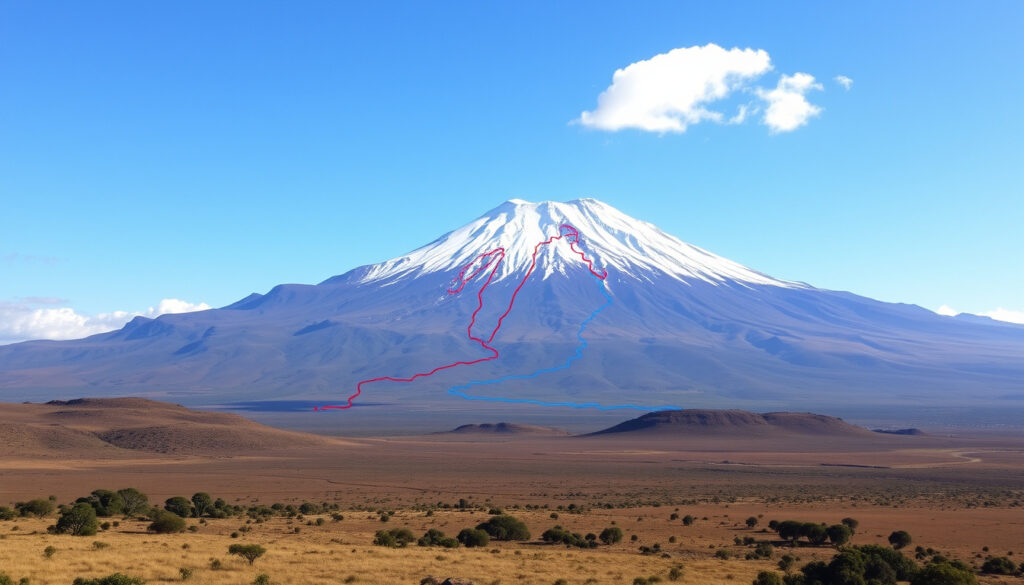
Standing at 5,895 metres (19,341 feet) above sea level, Kilimanjaro Peak is the highest point in Africa and the tallest free-standing mountain on Earth. Located in Tanzania, near the border with Kenya, this dormant volcanic peak attracts tens of thousands of climbers each year.
Despite its non-technical routes, Kilimanjaro is a serious high-altitude trek that demands physical endurance, proper acclimatization, and respect for the weather. The summit, known as Uhuru Peak, sits atop the Kibo crater and offers a unique experience for those prepared for the challenge.
How Tall is Kilimanjaro Peak?
- Height: 5,895 m (19,341 ft) – 4th most prominent peak in the world
- Country: Tanzania, East Africa
- Difficulty: Moderate to challenging – requires 8-9 days, no technical climbing
- Deaths: Approx. 3-10 per year (0.01% death rate)
- Kilimanjaro is the highest free-standing mountain on Earth (not part of a range).
- The summit is actually a volcanic crater named Uhuru Peak (meaning “freedom” in Swahili).
- Climbing Kilimanjaro does not require technical mountaineering skills but high altitude endurance.
- The mountain has three volcanic cones: Kibo, Mawenzi, and Shira; only Kibo is dormant, not extinct.
- Acute mountain sickness (AMS) is the leading cause of death and rescue incidents.
- Kilimanjaro’s glaciers are rapidly retreating due to climate change; scientists predict they could be gone by 2040.
| Fact | Value |
|---|---|
| Elevation (summit) | 5,895 m (19,341 ft) |
| Elevation at Base Camp (Marangu Gate) | 1,870 m (6,135 ft) |
| Elevation gain (typical climb) | ~4,000 m (13,000 ft) |
| Location | Tanzania, near Kenyan border |
| First ascent | 1889 – Hans Meyer & Ludwig Purtscheller |
| Annual visitors | ~35,000 climbers (2023 estimate) |
| Annual deaths | 3–10 (0.01–0.03%) |
| Peak temperature | -7°C to -20°C (typical at night) |
| Climbing duration | 5–9 days depending on route |
Where is Mount Kilimanjaro Located?
Which country is Mount Kilimanjaro in?
Mount Kilimanjaro lies entirely within Tanzania, in East Africa, approximately 300 km south of the equator. The mountain is part of Kilimanjaro National Park, a UNESCO World Heritage Site designated in 1987. The border with Kenya runs just north of the massif.
What is the nearest major city?
The closest urban centre is Moshi, a town at the foot of the mountain that serves as the main gateway for climbers. Most international visitors fly into Kilimanjaro International Airport, located about 40 km west of Moshi and 60 km from Arusha.
Since 1991, all trekkers must be accompanied by a registered, licensed guide within Kilimanjaro National Park.
How Difficult is Climbing Kilimanjaro?
What is the success rate for climbing Kilimanjaro?
Success rates vary significantly by route and itinerary. Longer climbs of 7–8 days generally report higher summit success because they allow more time for acclimatization. Some operators quote success rates above 90% on well-managed, extended treks, though overall averages are lower.
How long does the hike take?
Climbing Kilimanjaro typically takes between 5 and 9 days, depending on the chosen route. The most popular routes require 6–7 days of hiking, with daily trekking segments of 6–7 hours on average. The summit push starts very early in the morning to reach Uhuru Peak before midday.
What are the main climbing routes?
- Lemosho Route: widely recommended for first-time climbers and good acclimatization.
- Northern Circuit: also favored for acclimatization and safety.
- Machame Route: popular and generally strong for acclimatization on longer itineraries.
- Rongai Route: also listed among safer longer options.
- Marangu Route: shorter and faster, with less acclimatization; considered riskier.
- Umbwe Route: steep and rapid; riskier for altitude illness.
- Shira Route: starts unusually high, around 3,600 m, which increases altitude sickness risk.
Choosing a longer route and following the “climb high, sleep low” principle significantly reduces the risk of altitude sickness.
Is Kilimanjaro Dangerous?
How many deaths happen on Kilimanjaro each year?
Estimates from various guiding sources and park authorities indicate roughly 3 to 10 deaths per year among the approximately 35,000 annual climbers. One source reports that about 1,000 climbers are evacuated each year for medical reasons.
What causes most deaths on Kilimanjaro?
The primary cause is acute mountain sickness (AMS), which can progress to life-threatening conditions such as high-altitude pulmonary edema (HAPE) and high-altitude cerebral edema (HACE). The summit area above 5,500 m is considered functionally dangerous for unacclimatized climbers, even though it does not reach the 8,000 m death zone typical of Himalayan peaks.
Is Kilimanjaro an active volcano?
Kilimanjaro has three volcanic cones: Kibo, Mawenzi, and Shira. Kibo is dormant – its last major eruption occurred approximately 360,000 years ago. Mawenzi and Shira are extinct. Kibo could potentially erupt again, but the likelihood is extremely low in the foreseeable future.
If symptoms of AMS worsen – such as severe headache, nausea, or confusion – the only effective treatment is immediate descent. Ascending should stop until symptoms resolve.
What is the Weather Like at the Summit?
What temperature does it reach at Uhuru Peak?
Summit temperatures typically range from -7°C to -20°C at night, with strong winds and frequent snowfall. The mountain crosses five climate zones, starting with humid rainforest at the base and ending in arctic conditions at the top. Even during the dry season, the summit remains bitterly cold.
What is the best time of year to climb?
- July to October: dry and cooler; a peak climbing window.
- December to February: warmer with good visibility.
- March to May: long rainy season; trails can be wet and muddy.
- November to mid-December: short rainy season.
Key Milestones in Kilimanjaro History
- 1889: First documented ascent by Hans Meyer and Ludwig Purtscheller.
- 1920s: First tourist climbs organized.
- 1973: Designated as a national park (Kilimanjaro National Park).
- 1987: UNESCO World Heritage Site designation.
- 2000s: Rapid glacier retreat documented.
- 2020: Record number of climbers (pre-COVID).
- 2025: Ongoing monitoring of climate impact on summit ice.
Debunking Myths and Clarifying Uncertainty
The following table separates established facts from common misconceptions and areas of uncertainty.
| Established information | Information that remains unclear |
|---|---|
| Kilimanjaro is not evil. The question likely stems from confusion with the word “Jebel” (mountain) or myths about evil spirits; no scientific or historical basis exists. | Exact annual death figures vary by source; the commonly cited range of 3–10 per year may underreport due to incomplete records. |
| K2 (8,611 m) is a separate mountain in Pakistan, unrelated to Kilimanjaro. | Future glacial melting timelines remain uncertain; predictions of complete ice loss by 2040 depend on climate scenarios. |
| Kilimanjaro is not an active volcano; Kibo is dormant, last erupting ~360,000 years ago. | Some historical details of early ascents are debated among historians. |
Why Kilimanjaro Peak Matters Today
Beyond its status as a bucket-list destination, Kilimanjaro holds significant scientific and economic importance. The mountain’s rapidly retreating glaciers have become a prominent symbol of climate change, drawing researchers from around the world. Tourism generated by the peak supports thousands of local jobs and contributes substantially to Tanzania’s economy. Additionally, Kilimanjaro serves as a natural laboratory for altitude medicine, helping scientists understand how the human body responds to extreme environments.
Sources and Authoritative References
“Mount Kilimanjaro is the highest mountain in Africa and the highest free-standing mountain in the world.”
— Wikipedia, Mount Kilimanjaro
“Kilimanjaro National Park was established in 1973 and inscribed as a UNESCO World Heritage Site in 1987.”
— Tanzania National Parks (TANAPA)
“The glaciers on Kilimanjaro are rapidly retreating; scientists predict they could disappear by 2040.”
— Thompson et al., scientific studies on glacial retreat
Plan Your Own Kilimanjaro Adventure
To maximise your chances of a safe and successful summit, choose a route with a duration of at least 7–8 days, prioritise acclimatisation, and book with a licensed operator who employs certified guides. Prepare for extreme cold at the summit regardless of the season. For travel logistics, check Ryanair Cabin Bag Size 2025 – Dimensions, Rules and Fees and Hotel du Vin Exeter – 4-Star Luxury Near City Centre for accommodation and packing tips when planning your trip.
Additional Common Questions
What is the best time of year to climb Kilimanjaro?
July to October and December to February are the best windows, offering dry conditions and clearer skies.
How much does it cost to climb Kilimanjaro?
Costs vary widely by operator and route, typically ranging from $2,000 to $5,000 for a full guided climb.
Do I need oxygen to climb Kilimanjaro?
No, supplemental oxygen is not required. Proper acclimatization and a slow ascent are sufficient.
What is the success rate for summit attempts?
Summit success rates vary by route; longer itineraries (7–9 days) generally achieve rates above 80%.
Is Kilimanjaro harder than Mount Everest base camp?
Kilimanjaro is technically easier but may be physically harder for some due to the rapid ascent profile.
Can a beginner climb Kilimanjaro?
Yes, many beginners succeed with adequate physical preparation, a longer route, and a reputable guide.
What gear do I need for the summit?
Essential gear includes warm layers, a windproof jacket, insulated boots, gloves, hat, and a headlamp.
How do I train for Kilimanjaro?
Focus on cardiovascular endurance, long hikes with elevation gain, and leg strength exercises.
More related posts
 New Balance 2002R Protection Pack – UK Restock 2025 Guide
 How Many Seconds in a Day – Exact Calculation Explained
 Lego Set – The Ultimate Guide to Finding the Perfect Build
 Participation Lineup for 2025 Download Fe tival – Full Guide
 Julia Wandelt – Guilty of Harassing Madeleine McCann’s Parents
 Marks and Spencer Dundee – Store Guide, Hours, Jobs and Updates
 18K Gold Price Today – Live Rate and Market Analysis in Iran
 Eubank vs Benn Fight Time – Ring Walk Schedule and TV Guide